 New York City is a fabulous city where everyone would like to live in. The nightlife, the people, the numerous attractions, crowded streets and the yellow cabs make it a famous, popular and attractive metropolis. So, you have all the reasons to move to the “City that never sleeps”. Still, you should know that buying an apartment or a house in New York City can be quite expensive. If you’re on a budget, the best option is to rent an apartment. There are dwellings that can be rented for hundreds of thousands of dollars, but there are also condos that cost a couple of thousands of dollars per month. Thus, if you have a set amount of bucks, let’s say $2,600, here is what you can find. For this price, homes are quite decent and they’re located in popular and safe neighborhoods.
The first option would be an apartment located in Williamsburg, Brooklyn. This attractive apartment can be found at 84 South 1st Street and it features a balcony, large windows and a huge living room. It also has a built-in closet. The kitchen has the finest finishes, custom cabinets and stainless steel appliances from Blomberg, Bosch and Broan. The monthly rent is $2,500 and it requires no fee.
Next, you might want to take a look at the following apartment situated in Long Island City. The monthly rent for this one is $2,595. The dwelling measures 650 square feet and has only one bedroom. It features a large bathroom and huge windows. Additionally, it comes with radiant heated floors. The condo building is located at 26 – 26 Jackson Avenue and has numerous amenities such as doorman, gym, roof deck, sky gym and outdoor kitchen. The apartment is available unfurnished and furnished and pets are not allowed in the building.
Another option would be a beautiful 3-room condo in West Village. It’s situated at 210 West 10th Street and because of its location it costs $2,675 per month. The kitchen area is gorgeous. Even though it’s small, it is equipped with all necessary appliances: refrigerator, cabinets, oven / stove etc. The bedroom is spacious. Pets are allowed in this building that also features a wonderful roof deck.
If you’re looking for something more convenient, you should look at the following condo in Park Slope. It measures 800 square feet and has 2 bedrooms. The monthly rent is $2,550. The apartment is spacious and it features skylights and decorative mantles. The building situated at 335 First Street has all the utilities included and offers free Wi-Fi. Not to mention that it’s located close to the Farmers Market, 6th and 5th Avenues and Byrne Park.
The Upper East Side will surprise you with a 2-bedroom apartment located at 343 East 66th Street. The dwelling is quite large and it costs $2,575 per month. It features numerous windows and it’s very sunny and bright. The large bath and the kitchen have been recently renovated and they have a modern design. Last but not least, take a look at the duplex situated in the Upper West Side. It has one bath and a half bath, a balcony and a beautiful fireplace. It costs $2,700 per month.

East Village an Artistic Creation
East Village is a New York neighborhood in Manhattan. It is east of Greenwich Village and south of Stuyvesant Town and Gramercy Park. The Lower East Side lies to the south. East Village is further subdivided into the smaller neighborhoods of the Bowery and Alphabet City.
The region used to be part of the Lower East Side, but it began to develop a character of its own in the later part of the 60’s when many musicians, artists, and students moved to the location. They were attracted by the low rents and the existing base of beatniks who been living there since the early 50’s. The area was already considered the center of counter culture in the city.
The East Village is renowned for being the birth place of multiple artistic movements such as punk rock and the Nuyorican Literary movement. The area has also seen its share of riots and protest.
The district is famous for having a vibrant nightlife. It is quite diverse in nature. In recent years it has undergone extensive gentrification which has altered the zone’s character somewhat. The cheap rents that once attracted so many struggling artists are certainly a thing of the past.
Farming and Speculation Marked Early Years
East Village began as a farm owned by General Wouter van Twiller. In 1651, Peter Stuyvesant bought the farm. His family held title to the land for 7 generations. They began selling off parcels of their property in the early part of the 19th Century. High end townhouses began popping up along the roads until a flood of German and Irish immigration in the 1840’s and 50’s swelled the local population.
Speculators began constructing multi unit buildings on parcels intended for single family homes. They rented rooms and apartments to working class immigrants, many of whom were from Germany. Throughout the later half of the 19th century, the district was home to the third largest metropolitan population of Germans outside of Vienna and Berlin. It became America’s first foreign language neighborhood.
Many ethnic social, political\cal, recreational, and sports clubs were set up. While the buildings that housed these associations often still remain, the Germany character of the region began to decline. New immigrants continued to flock into the area at the end of the 19th Century, but now they were more often Polish of other East European stock. After World War II, a large number of Ukrainians settled here.
New Land Created through Fill
The East Village used to end at the East River at Avenue D., but fill was used to push the shoreline out in order to accommodate Franklin D. Roosevelt Drive. Much of the rubble used for this project was shipped across the Atlantic from England. It consisted of debris gathered in London and other spots that had been ravaged by aerial bombardment during the war.
East Village still exhibits the creative spirit that allows it to transform the mundane into something marvelous. Perhaps this is why artists have long been attracted to this spot.
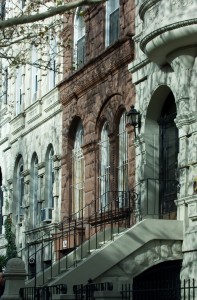
Sales of townhouses are seeing a boom. According to recent reports, construction on new townhouses has increased significantly, nearing levels the country saw before the housing market slump. Nonetheless, market share is still lower than what we’ve seen in years past.
Nationwide Trends
Comparing year-to-year data, starts of townhouses are up. During the second quarter of 2012, there were 17,000 starts, compared to 11,000 starts at this same time last year. If we look at a moving average of one year, the current market share of townhouses is 11 percent of single family starts. This is up from 10.4 percent during the first quarter of 2012.
The townhouse market saw its peak at the beginning of 2008, when market share was 14.6 percent. This after a consistent rise during the 1990s.
Manhattan Trends
Sales of townhouses in Manhattan are also up. The first half of 2012 saw an upswing in the total number of one- to three-family townhouses sold compared to three years earlier. Comparing sales of townhouses over several years, they are up 43.8 percent from this time last year, 4.5 percent from this time in 2010, and a sizable 76.9 percent from 2009.
Although sales are up, the island still isn’t seeing the same level of activity as before the slump. 2012’s year-to-date total is still 20 percent below that of 2008. The median sale price is also down 17.1 percent from 2008, resting now at $3.36 million.
Townhouses are seen as a higher-end housing alternative in Manhattan, and account for about 2 percent of total residential sales, which includes apartments. Overall, sales of higher-end properties are faring better than other pockets of the market.
Experts believe that these increases point to an overall rebound in the market, and that progress is being made in the development market. Developers are becoming more aggressive because of today’s credit and pricing, and they are eager to get a bigger return on their investment.
Townhouses are part of the luxury market, and some Manhattan properties are seeing sales in the tens of millions. In 2010, the Upper West Side saw some of these incredible sales, including townhouses that sold for $19.4 million (26 West 76th Street), $18.9 million (22 West 75th Street), and $22.4 million (247 Central Park West). Developers have taken note of these huge sales and are responding accordingly. Other recent sales include a townhouse at 137 West 74th Street, that broke a sales record for a property not located on a Central Park block.
Buyers, especially foreign buyers, also feel the process of buying a townhouse is easier. Typically there are no co-op boards to deal with and no microscopic evaluation of your financial records and history.
Experts believe that the spike in the market can mostly be attributed to developers, though. Developers seem keen on being in the luxury market and are now converting multi-family townhouses into single-family units. Townhouses on 115th, 121st, and 126th street on the west side of Park Avenue are seen as a prime location for this type of activity.
With all this data, one thing is clear – townhouses are becoming quite popular again.
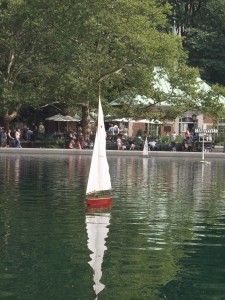
Central Park a Famous Place to Enjoy Nature
Central Park is a large public park located in the middle of Manhattan. This New York park originally opened in 1857 on 843 acres of land owned by the city. Frederick Law Olmsted and Calvert Vaux won a design contest in 1858 to expand and improve the park. The two also designed Prospect Park in Brooklyn. Their design for Central Park was called the Greensward Plan. Work on it continued through the Civil War until completion in 1873.
In 1962, Central Park was declared a National Historic Landmark. The park is managed through a non-profit agency, the Central Park Conservancy. The park’s northern end is West 110th St. 59th St. is the southern end. The western edge is 8th Ave., and 5th Ave. is the eastern edge.
Central Park is the most visited urban park in the U.S. receiving some 35 million visitors annually. It is a proximately 2.5 miles long and about .5 miles wide. It has served as a model for many other urban parks such as Vancouver’s Stanley Park, Tokyo’s Uenoe Park, and San Francisco’s Golden Gate Park.
Natural Appearance Part of the Design
While much of the park looks like natural land forms, it is almost entirely artificially landscaped. Its lakes and ponds were all created to look natural. There is an extensive system of walkways and bridle paths. The park contains two ice skating rinks, one of which is converted to a swimming pool in summer months. The park also contains a zoo, conservancy, wildlife sanctuary, large wooded area, and a 106 acres reservoir encircled by a running track.
“Shakespeare in the Park” is presented every summer at the Delacorte Theater. Other indoor attractions include the Swedish Marionette Theater, a historic Carousel, and the Belvedere Castle which houses a nature center. There are also seven major lawns or meadows, and several smaller grassy areas that are used for sports and relaxation. There are also a number of enclosed playgrounds for children.
Six miles of roadways are shared by skaters, bicyclists, joggers, and walkers. The real estate value of all this has been estimated at over half a trillion dollars.
City’s Early Growth Spurred Need for such Space
The population of New York City quadrupled between 1821 and 1855. The only open spaces at the time where people could get away from the noise and congestion of the metropolis were found in cemeteries. William Cullen Bryant, editor of the Evening Post which later became the New York Post spearheaded the drive to create a great public park. Many influential New Yorkers agreed on the need for such a space.
In 1853, the New York State Legislature agreed to purchase a 700 acre tract comprising most of the park’s current land. $5 million was appropriated to purchase the land.
Olmstead’s Greensward Plan emphasized the project as “a democratic development of the highest significance.” It had an innovative design that called for “separate circulation” systems for use by pedestrians, horseback riders, and vehicles.
 If you are in the market for a new home, or you are a current homeowner who wants to refinance, finding the best interest rate is likely the number one item on your list of priorities. Since mortgage rates are at all-time lows, now is definitely the time to score the best deals. To make sure you get the best rate on your mortgage or refinance, follow these tips below.
Shop Around for the Best Rate
With rates at an all time low, the difference from lender to lender is not going to be big. But even small differences can add up in the end. It’s important to look at the rate down to an eighth of a point. For example, for a $300,000, 30-year fixed rate mortgage, the difference between a 3.75 percent loan and 3.90 percent loan adds up to almost ten thousand dollars in interest payments over the life of the mortgage. Wouldn’t you rather put that money to better use by upgrading a feature of your home, such as installing hardwood floors or new appliances?
Known the Costs and Fees
Everyone knows that interest is a cost incurred with a home loan. But most loans also carry other fees and costs. Here’s a breakdown of what you need to know:
- Application Fee – covers processing and credit check, median cost is $365.
- Loan Origination Fee – covers attorney fees, notary fees, and documentation fees, among others. Median cost is between $2,500 and $2,700, depending on the amount of your down payment.
- Appraisal Fee – covers cost of professional appraiser, median cost is $292.
- Points – these are one time fees that reduce the rate of your loan. One point is one percent of your loan’s amount. These fees are generally between 0 and 3 percent of the loan amount.
- Home Inspection Fee – your lender may require a home inspection, generally costing between $300 and $500.
- Private Mortgage Insurance (PMI) – if your down payment is less than 20 percent your lender will probably require mortgage insurance, generally costing between $50 to $100 a month.
Honesty is the Best Policy
Lenient lending practices are a thing of the past. Expect more paperwork, and for your lender to verify everything you submit. Be honest about your finances. Even if you have some trouble spots, your mortgage professional is there to help you.
Be Vigilant with Your Credit Score
Your credit score is the number one most important thing to a lender, determining not only if you qualify for a loan, but also what interest rate you get. A credit score of at least 720 is best. You could see a difference of up to 1.5 percent or more on your interest rate depending on your FICO score. Over time, that money definitely adds up.
Put Big Money Down
Make the biggest down payment you can. You’ll start out with more equity, and you’ll avoid purchasing Private Mortgage Insurance, outlined above. That can potentially save you between $50 and $100 a month.
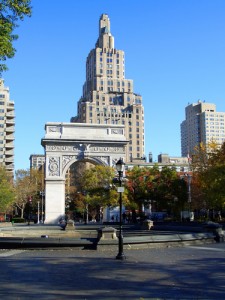 Greenwich Village or “The Village” is a residential neighborhood situated in New York City, Lower Manhattan. The district is mainly inhabited by upper middle class individuals. From the 19th to the 20th century, Greenwich Village was known as a bohemian capital, the Beat movement’s birthplace and an artists’ haven. The community’s attractive character caused its commercialization and gentrification. The Greenwich Village is bordered by 14th Street, Houston Street, Hudson River and Broadway. Also, the district is centered around New York University and Washington Square. The area is surrounded by neighborhoods like Chelsea, SoHo, NoHo and East Village.
Introducing the Charming Greenwich Village
Greenwich Village hasn’t lost its historic character and charm. As you pass by 6th Avenue and 14th Street, you can see how the grid system of Manhattan stops and its place is taken by narrow and crooked lanes. That’s how you know you’re in Greenwich Village. The oldest area in the neighborhood is the Meatpacking District, featuring cobblestone streets and industrial buildings. It is filled with bars and restaurants and the skyline is dominated by the Gansevoort Hotel. The entertainment locales and the residential buildings in the Meatpacking district highlight the New York flavor of the neighborhood. The atmosphere is completed by off-Broadway theaters, trendy cafés and jazz locales.
Greenwich Village used to be a rural hamlet, separated from the actual New York City. Throughout the years, it grew to be the most interesting areas in the lower Manhattan. In the 1950s, the section was filled with hipsters, writers, artists, poets and writers, creating a real precursor for the hippie scene. The following decade it attracted numerous folk music players and fans and various anti–war movements.
The Greenwich Village Attractions
Greenwich Village is also known for the Washington Square Park, the heart and center of the district. Other notable attractions are the playgrounds like Thompson, Minetta and Desalvio Street. The Cage or West 4th Street Courts is also a great playground. It includes handball and basketball fields and it’s used by professional New York players.
This area is famous for its Village Halloween Parade. It was started in 1973 by Ralph Lee, a puppeteer and mask maker. It is organized annually on October 31st and features a pageant of pets, masqueraders, puppets, mummers, druggies, drag queens, drunkards and exhibitionists. There are more than 2 million visitors that come every year to admire this weird parade. Greenwich Village is the place where you can never get bored. The restaurants, clubs and cafés are always at your disposal.
If you think Greenwich Village is the perfect place for you, then you might want to look for a luxury apartment or condo in the area. If you just want to test the district, you can choose to stay at one of the numerous hotels. For loft living accommodations select the Mercer Hotel. For first class accommodations, you must go for the Washington Square Hotel. It also offers walking tours of the neighborhood. The Minetta Suites are another great option. This unique place is situated on a secluded and small side street. The residential building features rooms with kitchenettes equipped with espresso machines, refrigerators and microwave ovens.
Berlin Has a Long and Interesting History
Berlin has long served as center of Germany. Even when the city was divided and no longer served as the capital of the country, it remained prominent commercially and culturally to the German people. Large numbers of foreign artists have long resided in the city giving it a highly cosmopolitan feel.
Berlin has not been subject to the sort of sprawl that besets many large cities. It remains a relatively compact but densely populated metropolitan area where the majority of inhabitants live in multi unit, multi story apartment houses,
In recent years, there has been a growing trend among affluent buyers to show a preference for units in older buildings built before the 2nd World War. Given that the city was long a major metropolis before then, there are thousands of such units in the city. A recent survey noted that more than a quarter of apartment buildings were built before the end of World War I, 1918. The structures that survived from this era were well built and are considered to hold far more charm than buildings more recently constructed.
Such charm does not come cheap these days. Older apartment averaged about $191,000 in selling price in 2011. That works out to around $207 per square foot. These figures were tabulated by the German property research firm Winters and Hirsch.
By comparison, units in buildings built between 1970 and 1990 run around 17% less than the older places while those constructed from 1949 to 1979 are cheapest of all dropping an additional 15%.
Higher Costs in Older Units
Buyers of such older units will find that they are more expensive to maintain. Real estate agents also warn that many older buildings fall under restrictions imposed by the government’s ensemble protection laws. These statutes are part of the city’s effort to preserve the historic nature of designated neighborhoods. Owners of such structures are forbidden to alter the façade of their buildings in any significant manner. Permission must be sought for altering such items as windows and doorways. Historic preservation laws add another layer of oversight to some buildings, but only about 3% of the buildings fall under such restrictive covenants.
These regulations can prove burdensome since many older buildings are poorly ventilated. Lack of proper air circulation can contribute to mold problems that are accentuated by Berlin’s fairly damp climate. Proposals have been made to alter these restrictions to accommodate such problems and to allow for additional changes that would allow for greater energy efficiency.
Such extensive changes could well cause prices to rise even higher both because of the costs involved as well as the fact that the results would be more desirable units. As it is, some foreign buyers have taken to renting their apartments out for well to do vacationers. Berlin is becoming an increasingly visited tourist destination.
Because of the growing demand, it is becoming increasingly difficult to secure a high end older apartment in Berlin, but it is easier to rent them out to vacationers.
Weekend Get-Aways of NYC Moguls
To get away from the sweltering heat of New York City, many of it’s elite residents head for nearby Long Island to take in some ocean breezes from their vacation homes in the one of the “Hamptons” villages including the Quoque or Sagaponack communities or Southampton Village, but others head for more faraway places.
The Hamptons
One property developer spends his weekends in Sagaponack, New York. The Village of Sagaponack was listed in 2009 as the most expensive small town in the United States by Business Week Magazine. So what does it cost to keep a summer home in America’s luxury zip code (11962)? In July 2012, Zillow listed the median home price in Sagaponack at $4.25 million—less than a quarter million lower than it’s high in 2009 at $4,421,458.
Nearby Southampton Village offers a more affordable option with the median list price at $1,285,000 for July 2012. Quogue home prices center around $ 2.75 million, up nearly 20 percent over 2011 prices.
Confusing to outsiders, the Town of Southampton includes seven villages and multiple communities and other “Hampton’s” communities are part of East Hampton. In addition to Sagaponack and Quogue, Southampton’s other incorporated villages include East Quogue, Shinnecock Hills, North Sea, Water Mill, Bridgehampton, Hampton Bays, Westhampton, Westhampton Beach, Westhampton Dunes, Southampton Village and part of Sag Harbor.
East Hampton includes the other part of Sag Harbor, East Hampton Village, Amagansett, Montauk, Northwest Harbor, Springs and Wainescott.
While the official boundary of “the Hamptons” actually begins about ten miles to the west at Westhampton, But, the Shinnecock Canal that joins Hampton Bays to Great Peconic Bay, is the popular dividing line. Northampton, a hamlet further west in the Town of Southampton generally is not included in the references to “The Hamptons” and the Shinnecock Reservation of the Shinnecock Indian Nation is adjacent to Shiinecock HIlls and the Village of Southampton, set within the Town of Southampton’s borders but not included in the designation of “The Hamptons.”
Florida Getaways
For more tropical weekend getaways, some New Yorkers head for Palm Beach Island, Florida. Separated from the mainland by the Intercostal Waterway, Palm Beach Island’s resort status was established in the late 1800s on the 16-mile-long barrier island. While the city retains a year-round population, most are considered to be “affluent” and more than half are over retirement age. The median home price on the 10-square-mile island is just under one million at $960,000 for July 2012.
Maine Vacation Spot
While the Hamptons are convenient and Florida is a great tropical getaway, some of New York’s elite residents head north instead to Ogunquit, Maine. Named by Yankee Magazine as a “Best Beach Town” in New England, Ogunquit offers sand, water and sun in a windswept locale along Maine’s southernmost coast. Other communities nearby include York and Wells. There are three miles of white sandy beaches and a cliff walk known as the Marginal Way that follows the coast for a mile and a half. Downtown Ogunquit is a quaint seaside city filled with speciality shops. Known as an artists’ haven, the resort town is just 70 miles from Boston so is easily accessible. Seaside luxury rental homes range from $2,500 to $5,000 per month and luxury resorts can run upwards of $6,000 to $10,000 per month (depending on the season).
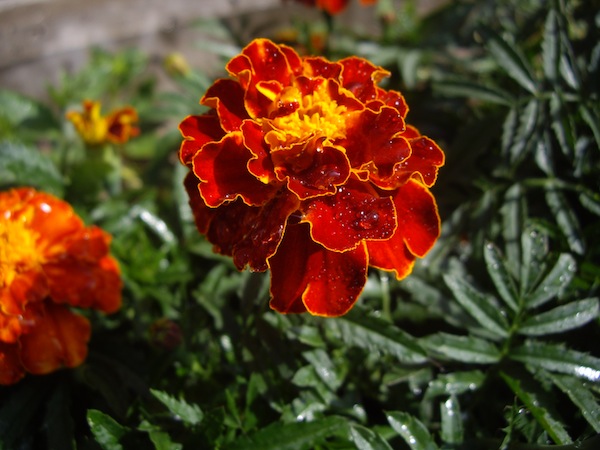 Summer may be over, but that doesn’t mean gardening season has to end. In fact, there are many varieties of plants and flowers that thrive in the fall climate. These plants will brighten up your fall landscape and give you plenty of blooms to enjoy throughout the season. Here are some excellent plants and flowers that you can plant now and enjoy until next spring.
Marigolds
Marigolds are typically thought of as summer flowers, since they tolerate heat so well, but they can also perform wonderfully in your fall garden. The red, gold, yellow and orange colors of their blossoms will enhance your autumn palette and complement the colors of the changing tree leaves. If you planted marigolds by seed in summer, those plants will continue to provide you with color well into fall. If not, you can certainly plant them now from packs purchased at your local garden center.
Roses
Not typically thought of as a fall flower, roses may surprise you with their show of color at this time of year. Roses tend to decline during the heat of summer, and can fall prey to insects and disease. But once the temperatures drop, pests and disease are less of a problem and your rose bushes may stage a wonderful revival right before they go dormant in winter.
Chrysanthemums
Many people think of mums when they think of fall color, and it is easy to see why. Mums are the gold standard of fall flowers and come in an array of colors we associate with the season such as purple, orange, burgundy, yellow, white and gold. Mums can survive somewhat cold temperatures and may even weather a frost or two.
Hellebores
Native to a Mediterranean climate, Hellebores can also be grown in the US and come in a variety of colors including yellow, cream, pink, purple, ruby and amethyst. They generally bloom from December through March, providing brilliant color at a time when your other garden plants will be dormant. Hellebores are poisonous, so do not eat them and wear gloves when handling to avoid a skin rash.
Flowering Shrubs
There are many varieties of shrubs that bloom in fall and winter including forsythia, wintersweet, honeysuckle, sweetbox, witchhazel, and viburnum. They can provide the perfect backbone to your fall garden.
Winter Iris
Winter Iris is a unique and special plant that flowers from October to March or April. It is hardy and can even survive a freeze. Although freezing will cause blooms to get mushy and fall off, those damaged will soon be replaced with new blooms once the temperature warms. Winter Iris comes in a variety of shades including white, yellow, pink, striped and spotted.
Just because the temperatures have dropped doesn’t mean you have to stop gardening. In fact, just a few hours in the garden this fall will pay off with blooms that you can enjoy until spring arrives. Just plant one or more of the varieties above to create a fall landscape you will love.
Reade57 is a newly constructed condo building located in Lower Manhattan region of New York City. This building is full of high quality 1 bedroom, 2 bedroom, and 3 bedroom condominiums available in various spacious floor plans that offer plenty of outdoor space. All Readet57 condos are equipped with hardwood floors, beautiful floor to ceiling windows, and amazing views of the East River, City Hall Park, Hudson River, and the Gehry building.
The alluring glass and steel architecture is a sight to see if you’re ever in the Tribeca area. Reade57 is surrounded by unique shops, restaurants, and various destinations that you don’t want to miss. Reade57 has 84 apartments and features some modern attributes that you won’t find in surrounding apartment buildings. The kitchen areas in many units are gourmet kitchens with exquisite granite countertops and stainless steel appliances. The location, appealing amenities and unique features make Reade57 a model condominium for families of all sizes.
Building Information:
- Units: 84
- Stories: 21
- Green Building: No
- New development: Yes
- Ownership: Condominium
- Building year: 2011
- Pets: N/A
Building Amenities:
- Pied-A-Terre Allowed
- Sublets Allowed
- Building Amenities
- 24-Hour Concierge
- Attended Lobby
- Bike room
- Cable TV Ready
- Central AC
- Cold Storage
- Concierge
- Doorman
- Elevator
- Fitness center
- Garden
- High-speed Internet
- Laundry room
- Laundry service
- Lounge
- Outdoor Space
- Private Storage
- Storage
- Video Security
General Condo Amenities:
- Balcony
- Floor to ceiling windows
- Hardwood Floors
- High Ceilings
- Outdoor Space
- Stackable Washer & Dryer
- Terrace
Kitchen Features:
- Ceasar Stone Countertops
- Dishwasher
- Gloss Lacque Cabinetry
- Gourmet Kitchen
- Kitchen Island
- New/Renovated Kitchen
- High Quality appliances
- Wooden Cabinetry
Bathroom Features:
- Dual Sinks
- Glass Shower
- Marble Bathroom
- New or Renovated Bath
- Oversized Mirror
- Polished Chrome Fixtures
- Powder Room
- Rain Shower
- Soaking Tub
- Vanity
- Walnut Bathroom
Website: http://www.reade57.com/